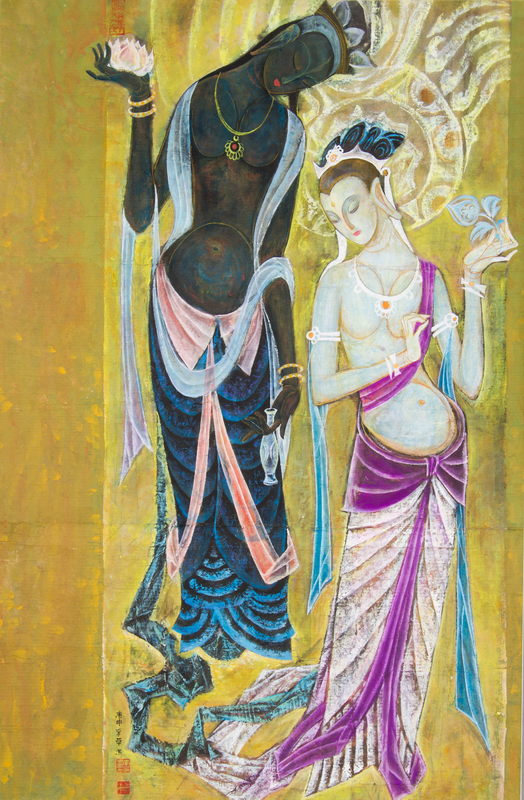
Two Boddhisatvas
Signed, dated 1980 and with three seals of the artist
1980 148 x 97.5 cm
Private Collection
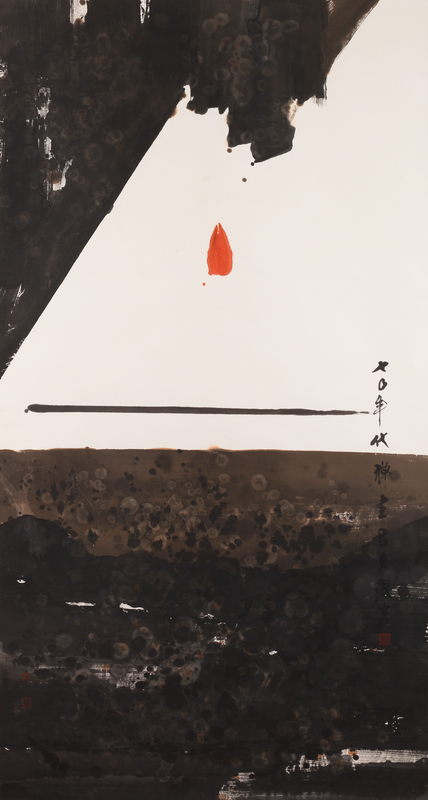
Lui Shoukwan Zen Lotus 1970
179 x 97 cm
Hanging scroll Signed, titled, dated and with three seals of the artist
Private Collection
Transcultural Ink
Manifesto
Transcultural Ink
The initial focus of this site is the ink-art of China. The transcultural approach to art is very recent phenomenon in a world where major cultures have tended in the past towards mutual cultural antipathy, often contempt. The concept of transculturalism, however, offers the promise of a rather more enlightened approach in the future and broader aesthetic horizons. It is our conviction that as transculturalism becomes mainstream, the maturity and sophistication of the ink-painting tradition of China will have a significant impact on the emerging, globalized art.
From the fifteenth century onwards expanding maritime adventures introduced China to the West but barely scratched the surface of its art and completely failed to recognize its aesthetic sensibility. Europe at the time valued Chinese crockery far above its more sophisticated arts and sought trade treasure rather than any cultural input beyond the exotic. It was not until the modern western revolution in the arts began to lift the obscuring veil of cultural bias that some aspects of Far Eastern aesthetics earned a degree of respect. Hints of the influence of Chan (Zen) Buddhist ideas, and their perceived expression in the visual arts crept into western consciousness, along with the visual influence of the essentialization required of the lower-level, popular Japanese art of print-making.
In China western aesthetic ideas only began to filter, barely perceptibly, into the ink-painting tradition in the seventeenth century; with the signs of a truly transcultural art found only in the eighteenth century when missionaries from Europe were welcomed at court for their scientific, technical skills with a few of them learning to master the ink-painting tradition. The Italian, Giuseppe Castiglione (Lang Shining, 郞世宁 (1688-1766), highly trained as an artist before arriving in China, stands out amongst them. He served all three eighteenth-century emperors, and mastered not only the language and calligraphy, but ink-painting as well. In the sense of being a foreigner who contributed significantly to the Chinese artistic tradition, we might consider him the first truly transcultural artist of note in Chinese history. His masterly ink paintings, seamlessly blending the technical skills of his Renaissance forebears with the brushwork skills and media of the ink-painting tradition, survive mainly in the imperial collection, and were recognized as the equal of masterpieces by ethnic Chinese artists.
Since then, western painting styles and media were introduced but had little influence over the mainstream ink-painting tradition. A century or more of confusion from the late nineteenth century to the present day has done little to change this. In the late-nineteenth century, accepting the need for political and technological improvement borrowed from the West, one school of thought sought to follow the western lead in art in order to ‘modernise’ Chinese art, but missed the point that ‘modernism’ didn’t and couldn’t resolve the problem.
This is discussed in the various essays appearing here, and two books recently published: The Art of Understanding Art. A New Perspective, now sold out but rewritten and published as Art Reboot. A transcultural re-evaluation of the nature and purpose of art that finds in China’s ancient past the resolution of global confusion in the modern art world.1
The transcultural theory of art and consciousness I propose to resolve the confusion reveals some radical shifts in understanding that are worth exploring. One is that the terminology we have imposed in attempts to arrive at a transcultural theory of art is, itself, part of the problem. By adopting the western concept of modernism and trying to apply its tenets to Chinese art we are simply perpetuating the problem of cultural bias and prejudice. It prompts us to seek similar modernity in other cultures, despite the fact that the theoretical shift I propose reveals that if we recognize the true nature of the modern western revolution in the arts and what it has really overthrown (revolution by definition sets out to overthrow some perceived tyranny) we can recognize that Chinese art has been ‘modern’ for centuries. To try, therefore, to modernise it based on western ideas of modernism can only cause confusion.
We face a similar problem with other exported words, ‘tradition’ being one of them. By opposing modern and traditional the implication is that the latter was unevolved, the baggage of purely western meaning was dumped on the doorstep of a more mature, fully emancipated painting tradition and became meaningless and confusing.
The term ‘abstract’ is equally misleading when exported, adding further confusion in attempts to understand the Chinese ink-painting tradition.
A clearer picture emerges if we look upon what happened in the West as the final emancipation of art from centuries of servitude to religion, philosophy, and the rational, post-Hellenistic preference for the intellectual way of knowing which led to science. The last may be the least obvious servitude but it is the most pervasive. It demanded recognizable subject matter based on objective reality, thus favouring a focus on the art object and its surface meaning. Further confusion arose from trying to apply object-based aesthetic theory to the process-based approach favoured in China for millennia. The Theory of Art and Consciousness proposed here is process based. When we rely upon the art object as our main guide to understanding its meaning, it may be difficult to come to terms with a blank white canvas, silent music, an upturned urinal, or Tracy Emin’s bed, but they are all rendered sensible as art when we focus not on the object but on what it communicates. The question shifts from ‘is this object art?’ to ‘does my interaction with it enhance my understanding?’
There are only two fundamental revolutions in art. The first is when art is recognized as a distinct pursuit, for whatever immediate purpose; the second, when it is liberated from servitude to religion, philosophy and science; only then does it become fully mature and efficient. This final emancipation removes the rules that were seen as governing art, including the rule that the first step in approaching it was to determine, at the level of the art object, whether or not it even qualified as art. In emancipated, fully mature art, rules arise out of the process of creativity rather than being imposed upon it.
The theory sees art as a sophisticated multi-level, meta-language in the service of evolving consciousness, its ultimate purpose, self-cultivation. Informing the self at ever more sophisticated levels of meaning is collectively the process of civilization.
This leads us to the conclusions that in so far as art is emancipated to full maturity, it inevitably reaches for transculturalism in any case. Once we accept that all our vehicles of self-consciousness have a common aim they are potential unified in purpose, so the closer aesthetics comes to ultimate efficiency in this quest, the more transcultural it becomes.
Another conclusion arising out of the theory I suggest is that Chinese art has been fully mature, and fully emancipated for millennia. We can trace the concept of art as self-realization back to at least the sixth century BCE. At that time painting wasn’t even considered an art form, but the concept of art in general was clearly recognized as being, above all, an efficient vehicle for self-realization. So when ink art evolved, beginning more than two thousand years ago, it already stood on the solid foundations of clarity as to the ultimate role of art.
Transculturalism is in its infancy. It will take time to transcend our focus on the art object and its surface meaning as defining the overall process of art. It will also take time to abandon the baggage of theoretical definitions inherited from western ideas. But without this crucial theoretical shift we not only face inefficiency in our approach to art in every facet of its meaning, we perpetuate the global confusion that permeates the art-world.
The criteria for selecting the artist we promote is based upon authenticity. Another word which fails to travel well from West to East. Object-based aesthetic theory sees authenticity as being defined by the art object. The art-object can only be either genuine or fake. Even with insufficient data to distinguish which, it remains a binary issue. The object is simply Schrodinger’s cat, which is neither confirmed as dead or alive until we open the box to check, or with the art-object until we can decide whether it is authentic or not – usually with art, the equivalent of dead or alive. If we shift to a process based theory, however, authenticity is applicable, albeit more subjectively, to every aspect of the process.
The essay on Authenticity explores the nuances of the process-based approach and will explain in greater detail why our assessment relies upon authenticity of:
- Intention. The artist’s reasons for creating art.
- Vision. The depth of meaning informing the artist.
- Perception. Every aspect of creation is an act of self-realization so the artist simultaneously acts as his or her own audience long before a wider audience is involved - the artist learns with every brush stroke.
- Means. What is involved in allowing expression including medium and acquired skills.
- The art object.
- Presentation. How the art is presented to an audience by the artist.
We can base our assessment of artistic authenticity, and therefrom, integrity on these points. What ultimately matters in art, therefore, is not what is done, but how and why it is done and what it means at ever more profound levels. Art is a conduit between the explicable and the inexplicable, the mundane and the spiritual, it bestrides the full bandwidth of consciousness without which the fulfilment of the evolution of consciousness is impossible.
The same process of authenticity can be applied to the audience, in all its various facets, whether collectors, dealers, academics, connoisseurs, critics, curators, et. al. Often the distinction between them becomes blurred, but authenticity of response can be equally meaningful on the other side of the physical art-object, along with the integrity to which it leads.
Hugh Moss
At the Water, Pine and Stone Retreat, Hong Kong, October 2023.
Art Reboot is available from OM Publishing, Rm. 1501, M Place, 54 Wong Chuk Hang Road, Hong Kong , or from Pavilion Gallery, PO Box 79169, London, E9 9EX (Email: info@paviliongallery.com ). Various essays and related exhibitions are also available on e-yaji.com, also a portal for Chinese art.